

"Medical Disclaimer: This article is for informational and educational purposes only and does not constitute medical advice, diagnosis, or treatment. Always consult a qualified healthcare professional regarding any medical condition, symptoms, or treatment decisions. Never disregard professional medical advice or delay seeking it because of information you have read in this article."
Why the numbers surprise people
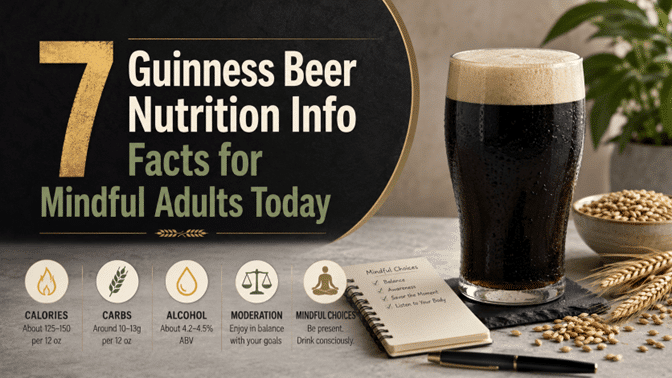
Guinness looks rich, dark, and creamy, so many people assume it must be one of the highest-calorie beers. The reality is more nuanced. Guinness Draught is a dry Irish stout with a distinctive roasted flavor and nitrogenated texture, but its calorie level per 12-ounce serving is often listed around 125 calories. A pint can be higher because the serving is larger, not because the beer is unusually heavy.
Understanding stout nutrition helps people avoid both myths: the myth that dark beer is automatically a calorie bomb and the myth that any beer is a health product. Guinness can fit into some adults’ occasional drinking patterns, but it is still alcohol. Calories, carbohydrates, alcohol content, serving size, and personal health context all matter.
Quick guinness beer nutrition info snapshot
| Guinness Draught Serving Information | Value |
|---|---|
| Standard Serving Size | 12 oz (355 mL) |
| Calories (per 12 oz) | 125 kcal |
| Carbohydrates (per 12 oz) | 10 g |
| Fat (per 12 oz) | 0 g |
| Protein (per 12 oz) | Small amount |
| Alcohol by Volume (ABV) | 4.2% |
| Serving Size Comparison | Relative Size vs. 12 oz Serving |
|---|---|
| 12 oz Bottle/Can | Standard reference serving |
| 16 oz U.S. Pint | About 33% larger |
| 20 oz Imperial Pint | About 67% larger |
The official Guinness FAQ describes the beer as made from roasted barley, malted barley, hops, yeast, and water, and notes that it does not contain caffeine or dairy. That is useful for people who wonder whether the dark color means coffee, chocolate, or milk ingredients. The color and flavor mainly come from roasted grain and brewing style, not dessert ingredients.
Calories in guinness beer nutrition info
Calories in beer come mainly from alcohol and residual carbohydrate. Because Guinness Draught is not very high in alcohol compared with many craft beers, its calorie count is moderate for beer. Strong stouts, imperial stouts, sweet stouts, and high-alcohol specialty beers can be much higher. Comparing all dark beers as one category is a mistake.
Serving size is the biggest practical issue. A 12-ounce can or bottle is easy to compare with other packaged beers. A pint at a bar may be 16 ounces in the United States or 20 imperial ounces in some settings. If a 12-ounce serving is about 125 calories, a 20-ounce serving can land near 210 calories.
Know more about Calories in Guinness Draught Stout Beer and Nutrition Facts.
Carbs in guinness beer nutrition info
Guinness Draught is commonly listed around 10 grams of carbohydrates per 12 ounces. That is not extremely high for beer, but it is not zero. People following a low-carb diet, managing blood sugar, or tracking macros should count it. Guinness 0.0, Foreign Extra Stout, and other variants can have different values, so the label matters.
Carbohydrate in beer does not bring the same fiber or nutrient package as whole grains on a plate. It contributes energy and flavor. That is not a moral problem; it is just a category difference. Someone can enjoy a stout while still understanding that it is not a substitute for nutrient-dense carbohydrate foods such as oats, beans, fruit, potatoes, or whole grains.
Alcohol content and guinness beer nutrition info
Alcohol affects the body beyond calories. It can impair judgment, reduce sleep quality, interact with medications, increase accident risk, and contribute to health problems when consumed heavily or frequently. Some people should not drink at all, including anyone under the legal drinking age, anyone who is pregnant, people advised not to drink for medical reasons, and people taking interacting medications.
For adults who choose to drink, pace matters. Have food with alcohol, drink water, and avoid driving. A lower-calorie beer is not a free pass for more drinking. The healthiest choice for many people may be to drink less or not at all. This should be clear in any responsible nutrition article about beer.
Comparing guinness beer nutrition info with other beers
Compared with some light beers, Guinness Draught may be slightly higher in calories, but it is often lower than strong IPAs, sweet stouts, high-alcohol craft beers, and many cocktails. Compared with hard seltzer, it may have more carbohydrate. Compared with a sugary mixed drink, it may have fewer calories. The right comparison depends on what the person would drink instead.
The mistake is comparing by color alone. Pale does not always mean light, and dark does not always mean heavy. Alcohol percentage, residual sugar, serving size, and recipe style are better clues. Guinness has a full flavor partly because of roasted barley and nitrogen texture, not because it is packed with cream or fat.
Ingredients and guinness beer nutrition info
The main ingredients are simple for beer: water, barley, hops, and yeast, with roasted barley creating the signature dark character. Guinness says its beer does not contain dairy or caffeine. This is helpful for people who associate stout with coffee or cream flavors. Flavor notes are not the same as ingredients.
People with celiac disease or gluten sensitivity should be cautious because barley contains gluten. Beer made with barley is not gluten-free unless specifically processed and labeled according to applicable standards. Anyone avoiding gluten should check the product label and choose a certified gluten-free option if needed.
Food pairing and guinness beer nutrition info
Guinness is often paired with hearty foods, but pairings can change the total meal dramatically. A pint with a burger and fries is different from a stout with grilled fish, stew, roasted vegetables, or a small plate of cheese. The beer may be moderate, but the food can make the meal heavy. Pairing with protein and vegetables creates a more balanced experience.
At home, stout can also be used in cooking, where a small amount adds roasted flavor to stews, sauces, or braised dishes. Cooking may reduce some alcohol depending on time and method, but it does not always remove all alcohol. People avoiding alcohol entirely should consider that before using beer in recipes.
Myths about guinness beer nutrition info
Myth one: dark beer is always high calorie. Not true. Some dark beers are moderate, while some pale beers are high. Myth two: Guinness is creamy because it contains dairy. Official FAQ information indicates it is dairy-free. Myth three: beer calories do not count if the beer is lower in alcohol. They still count, and alcohol still affects the body.
Myth four: stout is a good source of iron. Guinness contains roasted grains, but it should not be used as an iron supplement. People with iron deficiency need proper evaluation and treatment. Nutrition myths are common because beer marketing and pub culture can blur the line between enjoyment and health claims.
Smarter ways to enjoy guinness beer nutrition info
Choose the serving size intentionally, alternate with water, eat before or with the drink, and stop before alcohol affects your plans. If you want the flavor but not the alcohol, look at alcohol-free Guinness options and compare labels, because alcohol-free does not always mean calorie-free. If you are tracking calories, count the pint size correctly.
For social settings, decide ahead of time how many drinks fit your plan. This removes pressure in the moment. If you are not drinking, order a nonalcoholic option confidently. If you are drinking, sip slowly and enjoy the flavor. Mindfulness is not just for food; it applies to beverages too.
Mistakes to avoid with guinness beer nutrition info
The biggest mistake is using 12-ounce nutrition values for a larger pour. The second is assuming lower calories make multiple servings harmless. The third is ignoring alcohol interactions with medication, sleep, mood, and safety. The fourth is treating stout as nutritionally meaningful because it contains grain.
Another mistake is comparing Guinness Draught with Guinness Foreign Extra Stout or other variants without checking labels. Different products can have different alcohol levels and nutrition profiles. Always identify the exact beer. A brand family is not a single nutrition number.
Read more about Banana – The Quick energy Booster.
FAQs about guinness beer nutrition info
How many calories are in Guinness Draught?
A 12-ounce serving is commonly listed around 125 calories.
How many carbs?
Around 10 grams per 12 ounces is a common listing. Does it contain fat? It is commonly listed with zero grams of fat.
Does it contain caffeine or dairy?
Official FAQ information says Guinness does not contain caffeine and is dairy-free.
Is Guinness healthy?
It is an alcoholic drink, not a health food.
Can it fit into a balanced lifestyle?
For some adults who drink, an occasional serving can fit, but people with medical, medication, pregnancy, addiction, or safety concerns should avoid alcohol or ask a professional.
Is a pint the same as 12 ounces?
No, and that is one of the most important serving-size details.

