

"Medical Disclaimer: This article is for informational and educational purposes only and does not constitute medical advice, diagnosis, or treatment. Always consult a qualified healthcare professional regarding any medical condition, symptoms, or treatment decisions. Never disregard professional medical advice or delay seeking it because of information you have read in this article."
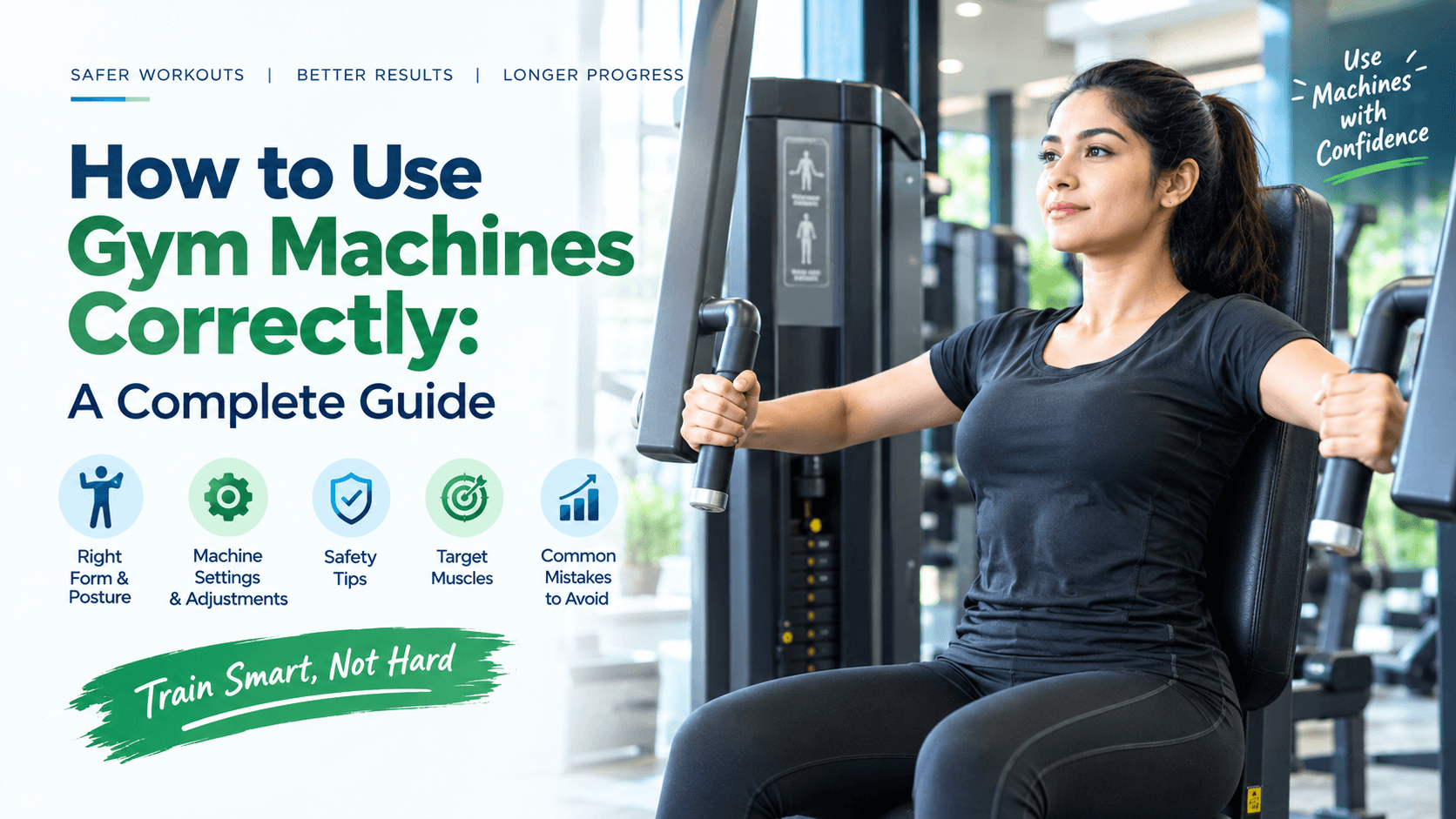
How to Use Gym Machines Correctly: A Complete Guide
To use gym equipment correctly, make sure that you have adjusted both the seat height and setting for your body size. Keep your spine in a neutral position. Move the weights with a complete range of motion while maintaining control. Avoid using momentum when lifting weights. Using the proper technique during exercise will help protect against injuries; it will also allow for maximum muscle activation; and it will enable you to safely progress as you begin to lift heavier weights.
Walk through any gym and you will see two types of people using machines: the first are the individuals moving weights quickly with short range of motion repetitions, and the second are the individuals who appear as if they are hardly working out at all since each movement is performed slowly, with control, and precision. Can you determine which type of machine user is going to build strength, and avoid having to go to a physical therapist?
One of the main causes for injury or plateauing in the gym is poor machine technique. When you perform a rushed chest press with your elbows flared out, you are putting strain on your shoulder joint rather than developing your pectoral muscles. If you perform a leg press with your feet placed too low on the platform, you will shift pressure onto your knees rather than developing your glutes and hamstrings. Poor machine technique is not an uncommon mistake; it occurs at almost every gym and during every workout session.
This article provides a step-by-step tutorial on how to correctly utilize gym equipment (or machines) for beginners and experienced users. From setting up as a beginner to understanding the mechanics behind the use of specific machines such as the leg press, chest press, lat pulldown, leg curls, and cable stations. At the conclusion of this tutorial, you should understand how to properly position yourself on each machine based on your individual physical dimensions, prevent the majority of common errors associated with improper form, and perform exercises in such a manner that they will produce results.
Why Are Gym Machines a Good Starting Point for Strength Training?
Gym machines direct your body’s movement through a predetermined path. Therefore, they are an excellent option for beginners as well as experienced lifters who need to recover from an injury or isolate a particular muscle.
Machines (such as cable machines) have a lower learning curve than free weights (such as barbells, dumbbells, and kettlebells) because they eliminate the need to stabilize the weight yourself. The machine’s frame will take care of balancing the weight, allowing you to concentrate on working the specific muscle group. This also decreases the possibility that you may drop the weight or lose control during a repetition.
Machines are not a long-term alternative to free weights. Free weights develop stabilizer muscles and functional strength that will transfer to everyday activities. On the other hand, machines are good at developing isolated muscle groups without needing as much coordination. A number of successful training programs incorporate both types of equipment.
Before using any machine, take a moment for basic safety checks:
- Confirm the weight pin is securely inserted in the stack.
- Check to see if both your seat and levers have been locked in place.
- Clear the area around the machine of loose equipment or other gym-goers.
- Start with a lower weight than what you believe is necessary, particularly when using a machine for the first time.
What Are the Essential Guidelines for Proper Machine Form?
Good form when using gym equipment involves five basic principles which are relevant for almost all equipment used in a gym setting.
Adjust the Machine to Fit Your Body
Machines are made with many options (e.g., seat height, backrest angle, lever arm length) that can be adjusted. One of the quickest ways to create strain on your body is to ignore these adjustments. For example, if you place a leg press too far away from your body, you will limit how much you can move. If you use a chest press machine with a seat that is too low, you may find yourself using your shoulders more than your chest. It takes only an additional 30 seconds to adjust the machine prior to adding weight.
Maintain Neutral Spine Alignment
Maintain the natural and neutral position of your spine during each movement. Try to avoid excessively arching or rounding your back, especially when using equipment such as the leg press and seated row, which can affect how well you perform and may lead to injury based on the position of your spine.
Control the Weight Through a Full Range of Motion
Moving through the full range of motion — not a shortened, partial movement — will recruit more muscle fibers and develop strength throughout the entire movement pattern. Slow down when lowering the weight during the eccentric (lengthening) phase of the lift, and do not stop short simply because the weight has become too heavy.
Avoid Momentum and Jerky Movements
The weight you’re using is too heavy if you have to throw, yank or utilize your body weight to lift it. When using momentum, the burden of lifting the weight will shift from the muscle group being targeted to the joint and/or connective tissue that was not designed to withstand that type of stress.
Focus on Breathing Properly
When you push or pull on the weight, take a breath out. When you let go of the weight, take a breath in. The Valsalva maneuver (holding your breath) is used by some experienced lifters, but it will raise your blood pressure and should only be used by people with the knowledge of how to use it safely, and should never be used on machines.
What Mistakes Most Commonly Cause Gym Machine Injuries?
Even the most serious gym goers fall victim to common pitfalls. Here are five of the most common errors to avoid:
Using too much weight at once, or “ego lifting” using machines, can lead to your body compensating by using other muscles, which causes damage to your joints rather than helping to build muscle.
Not warming-up. Cold muscles and connective tissue have a higher risk of being injured. A five-to-ten-minute warm-up, using either light cardiovascular exercise or dynamic stretches will prepare your body for stress.
Repetitions are made too quickly. When you use speed, you give up control, which is the most effective way to build muscle.
I am ignoring the signs of pain. Pain that results from having worked out is a natural response. However, pain in your joints, or pain that is more than just general soreness is not. If you experience either type of pain, you should stop working out right away.
An improperly adjusted machine will rarely fit your body properly regardless of how fit you are.
How Do You Use the Most Common Gym Machines Correctly?
Every machine has its general working principles, and every machine will have a number of specific ways to use that principle.
Leg Press: Place your feet about shoulder width apart on the platform while keeping your lower back supported by the padding. As you move the weight up, avoid locking your knees; as you move the weight down, do not allow your knees to collapse inward.
The chest press is done by setting the seat so the handles will be even with the center of your chest. During the entire movement, you need to keep your shoulder blades back and down. Also, use a grip width that allows for your elbows to be about 45 degrees away from your body, but not too wide.
Lat Pulldown: Move the bar down to your upper chest while pulling in a controlled manner, and squeeze your shoulder blades together. Do not allow the bar to go up quickly; instead, use the same amount of control when releasing the bar as you used when moving the bar down.
Leg curl: Place your knee at the same level as the machine’s pivot point prior to beginning. Keep your hips against the pad during each repetition so that you do not shift emphasis off of your hamstrings and on to your low back.
Cable Machines: Keep your core engaged to help support your upper body because cable machines provide a wider range of motion than fixed machines. Set up your body in relation to the cable machine so the cable is pulling directly towards the muscle you want to work, instead of being pulled at a weird angle.
How Does Proper Technique Help You Get Better Results?
Correct form isn’t simply for preventing injury – but rather it is the quickest route to seeing results.
Better muscle activation: Controlled, full-range movements use more of the muscle fibers in your body than sloppy, momentum-driven reps do. This results in more growth stimulation during each rep.
Progressive overload — as long as your technique is consistent — can be increased slowly and safely with the use of additional weight over a period of time; this is the basis for achieving long-term strength. Increasing weight too rapidly while still developing proper technique will only create more potential for injury.
The consistency of logging each set, rep and weight will allow you to see trends in your progress, identify plateaus, and determine the right time to increase the intensity of your workouts.
Pairing machine work with free weight training, bodyweight exercises, and mobility work will help develop a more balanced approach to building strength than using machines alone.
Start Training Smarter, Not Just Harder
The base of all your other workouts is proper form. When you lift more weight than you are ready for based on your current level of technical proficiency, this will not result in faster results; instead, it will lead to an increased rate of injuries.
Invest some of your time to learn how to properly use each piece of equipment at the gym prior to increasing the amount of weight on the stack. If you are a newcomer to the gym or if you are not sure that your technique is correct, hiring a certified personal trainer for one or two sessions will most likely be one of the greatest investments that you can make in your fitness endeavors.
Frequently Asked Questions
How long does it take to learn proper gym machine form?
Most people can acquire the fundamentals of proper machine mechanics in as little as 2-4 weeks with consistent practice; however, improving mechanics is a continuous endeavor during your entire training program.
Is it bad to use gym machines every workout?
Machines used consistently do not cause harm, but if you rely solely on machine use your stabilizer muscles will remain weak. You should combine both machine use and free weight training to create more evenly developed muscle strength.
What should I do if a machine doesn’t feel right for my body?
If a machine does not feel comfortable for you after adjusting properly, then do not use that machine. Every person’s physical body is different and there are other ways to work out those same muscles as well.
Do I need a trainer to use gym machines safely?
The use of a trainer is not mandatory, however, taking one or two sessions with a trainer may assist in correcting any form errors that may go unnoticed without professional guidance; this is particularly true for those who are just beginning their training.
What’s the biggest risk of using gym machines incorrectly?
The highest risk is joint stress from bad alignment or momentum based repetition that may cause long-term overuse injury to your shoulder, knee, or lower back.

