


"Medical Disclaimer: This article is for informational and educational purposes only and does not constitute medical advice, diagnosis, or treatment. Always consult a qualified healthcare professional regarding any medical condition, symptoms, or treatment decisions. Never disregard professional medical advice or delay seeking it because of information you have read in this article."
Swimming is often described as a full-body workout, but that phrase can feel vague when you are planning a fitness routine, writing a workout program, or deciding whether laps can support your strength goals. The real answer is more useful what muscles does swimming work: swimming trains the shoulders, upper back, chest, arms, core, hips, glutes, and legs at the same time, while the water adds resistance without the same impact you feel on land. If your main question is what muscles does swimming work, the best starting point is to look at how every stroke uses pulling, kicking, rotation, bracing, breathing, and body alignment.
This guide explains what muscles does swimming work in simple terms, then breaks the answer down by body area and stroke. You will also learn why swimming feels easier on the joints, how to build balanced sessions, and which technique habits help each muscle group do its job. The goal is not to turn every swimmer into a bodybuilder; it is to help you understand where the effort comes from and how to train with better purpose.
1. Why what muscles does swimming work feels total-body
When people ask what muscles does swimming work, they often expect a short list. In reality, the list changes slightly with the stroke, pace, kick pattern, and breathing style. Water creates resistance from many directions, so your body has to pull, press, stabilize, and recover with control. Unlike a machine exercise that isolates one joint, swimming asks many muscles to cooperate so the body can stay long, streamlined, and moving forward.
The upper body produces most of the visible propulsion during freestyle, backstroke, and butterfly. The legs help maintain body position and speed. The core connects the two halves so the power from a kick is not lost before it reaches the pull. That is why what muscles does swimming work is also a question about coordination. Good technique spreads effort across the whole body instead of overloading the shoulders or lower back.
2. What muscles does swimming work in shoulders and chest
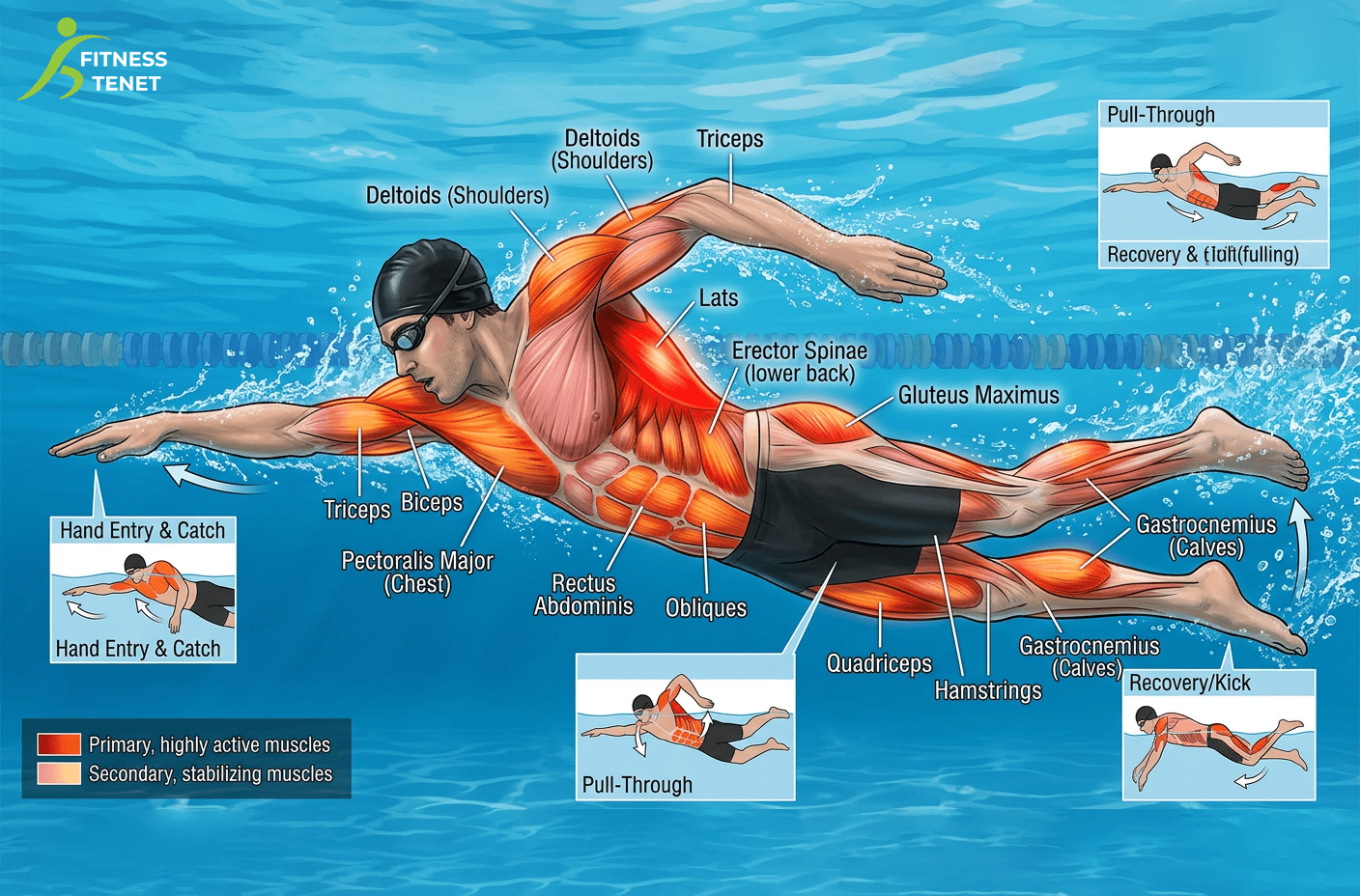
The shoulders are heavily involved in nearly every stroke. The deltoids lift and guide the arms during recovery, while the rotator cuff helps keep the shoulder joint stable as the hand enters, catches, and pulls through the water. When someone searches what muscles does swimming work, shoulder muscles usually deserve the first mention because they manage repeated overhead movement.
The upper back is just as important. The latissimus dorsi, trapezius, rhomboids, and posterior shoulder muscles help pull the body forward and maintain posture. A strong back allows the swimmer to anchor the hand in the water rather than simply spinning the arms. The chest, especially the pectorals, contributes when the arms sweep inward during breaststroke and during parts of butterfly and freestyle. If you want a practical answer to what muscles does swimming work for upper-body strength, think shoulders for reach, back for pull, chest for press, and small stabilizers for control.
3. What muscles does swimming work in arms and forearms
The arms do more than move in circles. The biceps bend the elbow during the catch and pull, while the triceps extend the elbow during the finish and help streamline the arm. The forearms and hand muscles help create a firm paddle against the water. For anyone asking what muscles does swimming work in the arms, the answer includes both the large visible muscles and the smaller muscles that shape the hand position.
Cleveland Clinic – 9 Health Benefits of Water Workouts.
Freestyle and backstroke use alternating arm action, which can make the arms work in a steady rhythm. Butterfly and breaststroke use both arms together, which can feel more powerful but more demanding. Paddles, pull buoys, and drill work may increase the feeling in the arms, but beginners should use equipment carefully because more resistance also increases technique demands. A smart swimmer learns to feel pressure on the forearm, not just the hand.
4. What muscles does swimming work in the core
A strong core is central to swimming because the body must stay stable while the arms and legs move. The rectus abdominis, transverse abdominis, obliques, spinal erectors, and deep hip stabilizers all help control body position. If your question is what muscles does swimming work for the midsection, the answer is not limited to the six-pack area. Swimming trains the whole trunk as a brace, a bridge, and a rotation engine.
CDC – Benefits of Physical Activity
Freestyle and backstroke depend on rotation from side to side. The obliques and deep core muscles help roll the body without letting the hips sink. Butterfly uses a wave-like motion that requires abdominal control and spinal rhythm. Breaststroke needs core timing so the kick, glide, and pull happen smoothly. When you understand what muscles does swimming work in the core, you can see why planks, dead bugs, bird dogs, and rotational exercises often support better swimming form.
5. What muscles does swimming work in hips and legs
The lower body matters more than many beginners realize. The glutes extend the hips, the hip flexors lift the legs, the quadriceps straighten the knees, and the hamstrings help bend the knees and control the kick. The calves and ankle muscles contribute to pointing, flexing, and snapping the feet through the water. When a coach hears what muscles does swimming work, they will often remind swimmers that weak or poorly timed kicks can drag the whole body down.
Freestyle and backstroke kicks use a small, fast flutter pattern that starts at the hips. Butterfly uses a dolphin kick that depends on the hips, core, glutes, and legs working like one connected chain. Breaststroke uses a whip kick that asks more from the inner thighs, hip rotators, hamstrings, and glutes. If your focus is what muscles does swimming work in the legs, the answer depends strongly on the stroke you practice most.
6. What muscles does swimming work by stroke?
Freestyle is the most common lap-swimming stroke, so it is usually the first answer to what muscles does swimming work. It emphasizes the lats, deltoids, rotator cuff, triceps, core, glutes, hip flexors, quads, and calves. The pull builds upper-back endurance, while the flutter kick helps keep the hips high. The obliques guide rotation, and the neck should stay relaxed as breathing fits into the rhythm.
Backstroke answers what muscles does swimming work from a slightly different angle because the swimmer faces upward. The posterior shoulders, upper back, lats, glutes, hip flexors, and core stabilizers all stay active. Backstroke can be useful for people who need a break from face-down breathing, but it still requires shoulder mobility and steady body alignment.
WHO – Physical activity fact sheet.
Breaststroke changes the emphasis again. If you ask what muscles does swimming work during breaststroke, include the chest, lats, biceps, forearms, inner thighs, hamstrings, glutes, and calves. The whip kick is the signature movement, and it can feel demanding on the hips and knees if mobility is limited. Smooth timing matters more than rushing.
Butterfly is the most intense stroke for many swimmers. When asking what muscles does swimming work during butterfly, think shoulders, lats, chest, triceps, abs, spinal muscles, glutes, hip flexors, quads, and calves. The dolphin kick and simultaneous arm pull create a powerful rhythm, but fatigue can arrive quickly. Short repeats, skill drills, and plenty of rest help keep the stroke efficient.
7. What muscles does swimming work versus lifting
A common follow-up to what muscles does swimming work is whether swimming can replace lifting weights. Swimming can build muscular endurance, coordination, cardiovascular capacity, and general tone, especially for beginners or people returning to exercise. However, traditional strength training is still better for progressive overload when the main goal is maximum muscle growth or peak strength.
8. What muscles does swimming work in beginner training
If you are using what muscles does swimming work as a planning keyword for your own training, start with balance. Warm up with easy swimming, then alternate technique drills, steady laps, and rest. A simple session might include 5 minutes of easy swimming, 6 x 25 meters of drill work, 8 x 50 meters at a comfortable pace, 4 x 25 meters kicking, and a relaxed cool-down. Adjust distances to your ability.
To make what muscles does swimming work more actionable, pair strokes with goals. Use freestyle for general conditioning, backstroke for posture and posterior-chain awareness, breaststroke for hip and inner-thigh engagement, and short butterfly drills for power and core timing. New swimmers should avoid forcing painful ranges of motion. Smooth movement beats hard effort when technique is still developing.
9. What muscles does swimming work when technique improves
The answer to what muscles does swimming work becomes clearer when technique improves. First, keep the body long. A streamlined position reduces drag, which lets the muscles create forward motion instead of fighting the water. Second, press the chest slightly down so the hips can stay near the surface. Third, rotate from the trunk in freestyle and backstroke rather than twisting only the neck or shoulders.
Fourth, enter the hand with control and aim for a strong catch. You should feel the lats and upper back engage as the forearm presses against the water. Fifth, kick from the hips, not only from the knees. Sixth, breathe calmly. Holding the breath too long can make the body tense, and tension often prevents the right muscles from working smoothly.
U.S. Masters Swimming – Swimming 101 Beginner Guide
Conclusion
So, what muscles does swimming work? Swimming works the shoulders, rotator cuff, lats, upper back, chest, biceps, triceps, forearms, abs, obliques, spinal stabilizers, glutes, hip flexors, quads, hamstrings, calves, and ankles. The exact emphasis changes by stroke, but the main lesson is consistent: swimming is a coordinated full-body exercise that rewards technique, patience, and balanced programming.
Use this knowledge to choose strokes, plan workouts, and understand where you should feel effort. If you want better posture and upper-back endurance, focus on freestyle and backstroke quality. If you want more hip and leg challenge, add careful breaststroke and kick sets. If you want power and core rhythm, practice small pieces of butterfly. The clearer your answer to what muscles does swimming work, the easier it becomes to turn each swim into a smarter fitness session.
Read more about Benefits of swimming exercise.
FAQs about What muscles does swimming work
Does swimming work the abs?
Yes. When people ask what muscles does swimming work for the abs, the answer includes the rectus abdominis, obliques, transverse abdominis, and deeper stabilizers. These muscles help maintain body line, connect the kick to the pull, and control rotation.
Does swimming work the glutes?
Yes. The glutes help drive hip extension in flutter kick, dolphin kick, and parts of breaststroke. For anyone wondering what muscles does swimming work below the waist, glutes should be included with the hips, thighs, calves, and ankles.
Does swimming work the chest?
Yes, but the emphasis depends on the stroke. Breaststroke and butterfly usually involve the chest more than easy freestyle. If you ask what muscles does swimming work for the front of the upper body, include the pectorals, anterior deltoids, and triceps.
Can swimming build muscle?
It can support muscle endurance and visible tone, especially when sessions are consistent and progressive. Still, if your goal is significant hypertrophy, combine swimming with strength training. The question what muscles does swimming work tells you which areas are active, but muscle growth also depends on resistance, nutrition, recovery, and progressive overload.
Is swimming good for beginners?
For many people, yes, because water supports the body and reduces impact. Beginners should start slowly, learn breathing basics, and use rest intervals. Asking what muscles does swimming work is useful, but learning how to move safely matters just as much.

