


"Medical Disclaimer: This article is for informational and educational purposes only and does not constitute medical advice, diagnosis, or treatment. Always consult a qualified healthcare professional regarding any medical condition, symptoms, or treatment decisions. Never disregard professional medical advice or delay seeking it because of information you have read in this article."
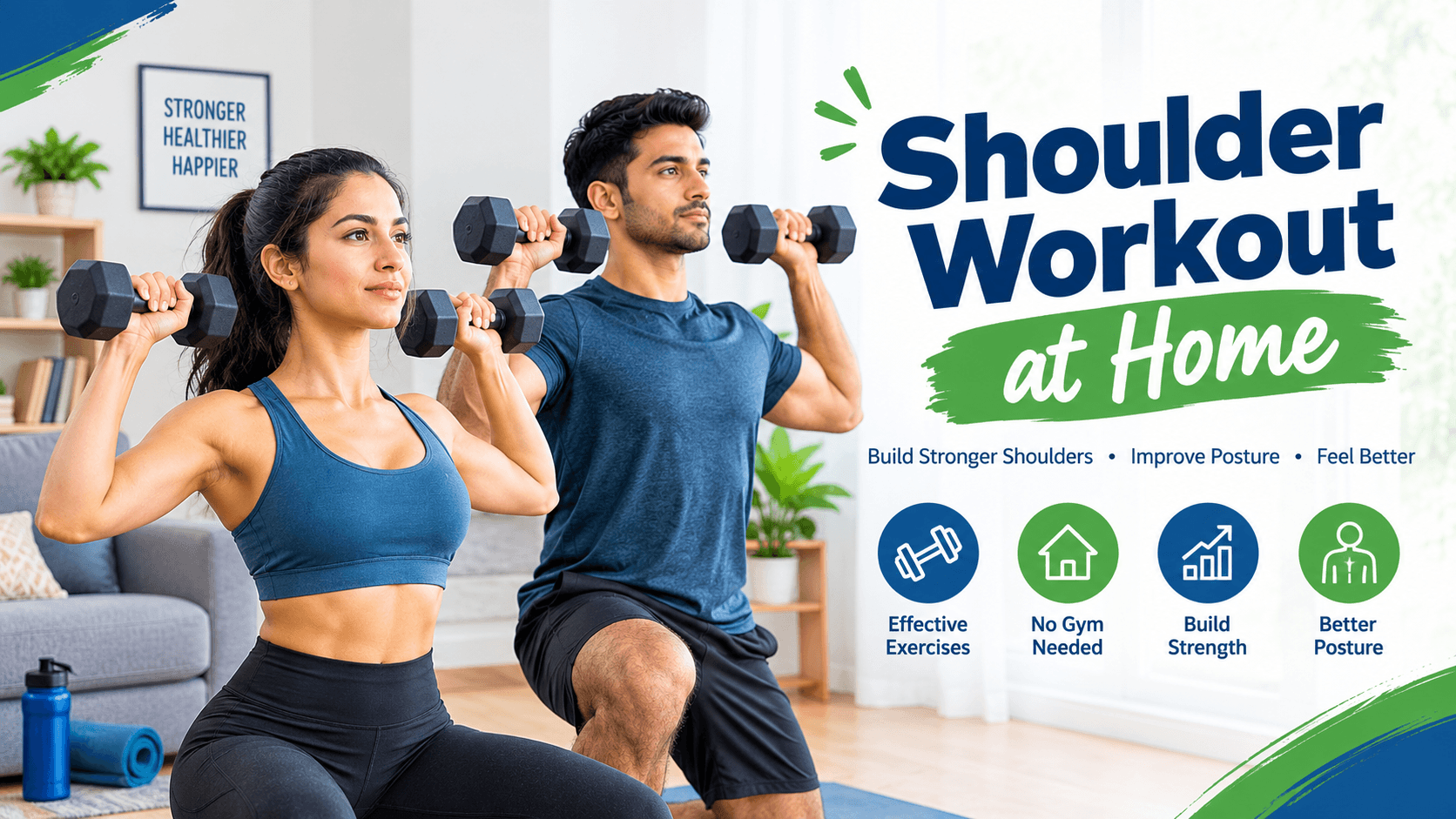
Shoulder Workout at Home
The ability to develop well-defined and muscular shoulders is achievable through home-based training with dumbbells, resistance bands, or with nothing more than your own body weight. This article will provide information on shoulder anatomy, the top home shoulder exercises, an example shoulder workout, some common errors that people make when training their shoulders, and how to properly recover after working out so that you may continue to train safely and effectively without a costly gym membership.
Strong shoulders help create an even, balanced appearance for the entire upper body, as well as providing support during almost all activities of the upper body (such as carrying heavy items like groceries, working at a computer for long periods of time, etc.) In addition to creating an athletic looking upper body, strong shoulders will provide better posture, decrease the chance of injury, and enable you to perform many daily functions with greater ease.
The good news is that you do not need to go to a gym to get your shoulders working effectively. A shoulder workout at home, performed consistently with correct form, will develop actual strength and definition in your shoulder muscles without the use of much equipment.
This tutorial will take you through the basic anatomy of the shoulder, some of the most effective exercises you can perform at home, examples of beginner and intermediate home routines, common pitfalls to avoid and the post-workout recovery practices that help develop muscle. At the conclusion of this tutorial, you will have all the knowledge necessary to begin developing your shoulders using home-based methods.
What Muscles Make Up the Shoulder?
The shoulder is driven by the deltoid muscle, which is divided into three separate parts:
The front of the deltoid, or anterior deltoid, is involved in all types of pressing movements, as well as lifting your arm forward in front of you. An example of this would be the use of a dumbbell to perform a shoulder press.
The lateral deltoid is responsible for how wide your shoulders appear. You can work on the width of your shoulders by doing lateral raises.
The posterior deltoid (rear) is often overlooked. It helps maintain a healthy posture, supports the shoulder joint, and reacts well to pulling exercises and reverse exercises (e.g., reverse flies).
Balanced shoulder workouts will work on each part of your shoulders. Many people who do home workouts focus on pushing exercises and don’t pay enough attention to their back shoulder muscles (posterior deltoids). Over time, this could cause you to develop muscle imbalances, rounded shoulders, and ultimately increase your risk of getting injured. When you create a complete shoulder workout program, you should train all three heads of the deltoids rather than just those that you can easily view in the mirror.
What Equipment Do You Need for a Shoulder Workout at Home?
You do not have to go to a full-size health club to effectively work on your shoulders. Some inexpensive and small pieces of equipment can allow you to perform many of the shoulder exercises available.
Dumbbell sets (either adjustable or static weight) allow you to perform various types of upper body exercises, such as pressing, raising and flying.
Resistance Bands – Light Weight, Portable and Great For Pull Aparts & Rear Deltoid Work.
If you do not have access to dumbbells and need something similar in size and weight, household items such as water bottles, book-filled backpacks, and/or canned food may be used.
If you would rather use only your own body weight when working out, then pike push ups can serve as an alternative to using weights during upper-body press exercises. Pike push ups do not require the use of any type of exercise equipment.
All that is required to create a minimal home exercise space is sufficient area to raise your arms above your head and a flat area where you can perform floor based exercises such as pike pushups. Most often, an empty space in either a bedroom or living room will suffice.
What Are the Best Shoulder Exercises to Do at Home?
Dumbbell Shoulder Press
The Dumbbell Shoulder Press is one of the most fundamental movements that provides the base for developing overall shoulder strength. To begin this exercise you can either stand or sit, while holding a dumbbell in each hand at shoulder level. Your palms should face forward. Press both dumbbells straight up above your head until you reach full extension of your arms. Then lower them slowly back down to their starting position. Repeat.
Lateral Raises
The lateral raise is used for targeting the lateral deltoid and increasing shoulder width. To do this exercise, you will hold a dumbbell in each of your hands and have them positioned next to your side. You then will lift both of your arms up to about shoulder level, while maintaining a small amount of bend in the elbows. Once you reach that point, you can begin to lower down slowly so you can get maximum engagement from the muscles.
Reverse Flyes
Reverse Flyes work the usually neglected rear deltoid. With a dumbbell in each hand, bend over from the hips, lift your arms out to the side and squeeze your shoulder blades together when you reach the highest point.
Pike Push-Ups
Pike pushups are a way to work out your shoulders without using weights. You will begin by standing on your hands and feet (like a dog) with your buttocks lifted high in the air. Then, you will lower yourself down until your face is close to the ground, and push back up.
Resistance Band Pull-Aparts
Band pull-aparts are great to engage the back of the shoulder and improve posture. To perform this exercise hold onto a resistance band with each hand in front of you. Next, pull the band apart by moving each arm outward from the body until the band is touching your chest.
Upright Rows
Upright rows are used to strengthen both the upper shoulder muscles (the deltoids) and the trapezius muscle group. To perform upright rows, hold a dumbbell in each of your hands and position them directly below your hips. Then, lift the dumbbells straight up towards your chest area, continuing to raise the dumbbells until you have reached the level of your shoulders.
What Does a Sample Home Shoulder Workout Routine Look Like?
Warm-Up (5 minutes)
Prior to lifting weights, you should begin to warm up your shoulder joints by doing arm circles, band pull-aparts using light resistance, and a few body weight shoulder rolls. A proper warm up will increase blood circulation and help reduce the risk of injury.
Beginner Routine:
- Dumbbell shoulder press: 2 sets of 10–12 reps
- Lateral raises: 2 sets of 12 reps
- Reverse flyes: 2 sets of 12 reps
- Resistance band pull-aparts: 2 sets of 15 reps
- Intermediate Routine
- Dumbbell shoulder press: 3 sets of 10 reps
- Lateral raises: 3 sets of 12 reps
- Reverse flyes: 3 sets of 12 reps
- Pike push-ups: 3 sets of 8–10 reps
- Upright rows: 3 sets of 10 reps
- Resistance band pull-aparts: 3 sets of 15 reps
Rest and Recovery
As a beginner, you should rest 45-60 seconds after each set. As an intermediate lifter, you should rest 60-90 seconds. You must also allow for a minimum of 48 hours of rest between your shoulder workouts so that the muscles can repair and grow.
What Mistakes Should You Avoid During a Shoulder Workout?
Using momentum as opposed to controlling your body during a repetition can lower the amount of muscular involvement while also increasing the risk of injury. Perform all of your repetitions slowly and with control.
The posterior deltoid is neglected when training with reverse flies and/or band pull-aparts. This results in an imbalance of the shoulders, which can result in poor posture. All three parts of the deltoid should be trained, not just the anterior (front) and lateral (side) portions.
If you train your shoulders daily and do not allow for sufficient time to recover, you will restrict your ability to gain muscle. You should select a training schedule (e.g., 2-3 times per week) that provides at least 48 hours for recovery after each workout.
Injury Risk Caused by Incorrect Form: Over-exerting yourself with excessive weight, specifically on overhead press exercises, places excessive strain on your shoulder joint. Give priority to your form rather than the amount of weight you lift; especially when first learning how to use the equipment.
How Does Nutrition and Recovery Support Shoulder Growth?
Protein Intake for Muscle Growth
Protein consumption is essential for both muscle repair and development. Consuming a source of protein (i.e., eggs, chicken, fish, or plant-based options) at every meal will aid in post-workout recovery from a shoulder workout.
Hydration and Post-Workout Nutrition
The act of drinking enough water will assist with joint lubrication and muscle performance when participating in physical activity. Consuming a well-balanced meal that contains both proteins and carbohydrates no later than two hours following the completion of your workout will aid in the restoration of depleted energy reserves as well as initiate the process of repairing muscle tissue.
Sleep’s Role in Muscle Recovery
During sleep, the body produces growth hormone and repairs tissues injured by exercise. Consistent shoulder growth can be achieved with quality sleep each day (7-9 hours).
Start Building Stronger Shoulders Today
You do not need to go to a gym to train your shoulders. You also do not need to have a lot of expensive equipment. All you need is a couple of dumbbells, a resistance band, and a regular training schedule to increase the strength of your shoulders, improve your posture, and create a balanced and defined set of shoulders.
The secret to success lies in consistency. Select a beginner- or intermediate-level routine that fits your needs in this guide; schedule yourself to work out two-to-three days per week; and combine those workouts with a well-balanced diet and adequate rest. Begin your first workout today and monitor your progress over time as your strength increases each week.
Frequently Asked Questions
How often should I do a shoulder workout at home?
The best way to build a good foundation of strength and allow for adequate recovery for muscle growth is to train your shoulders 2-3 times per week, with a minimum of 48 hours of rest between each session.
Do I need equipment for a shoulder workout at home?
No, as much as resistance bands and/or dumbbells will help you to perform some exercises more effectively; you can develop your shoulders’ strength by doing body weight exercises such as the pike push-up, without having to purchase anything.
How long does it take to see results from home shoulder workouts?
If you train regularly for 2-3 hours per week, you can expect to see an increase in your strength after 4-6 weeks of consistent training, and visual signs of muscle growth (definition) in 8-12 weeks, depending upon what type of diet you have and how quickly you recover from each workout.
What’s the biggest risk of training shoulders at home?
Risk associated with improper technique, specifically when performing press-type exercises, can result in injury to the shoulder. This risk can be minimized by utilizing lighter weights initially, as well as focusing on controlled movement.
Can beginners do intermediate shoulder exercises?
Beginners need to begin with lighter weights and fewer sets so they can develop correct form and joint strength prior to advancing to moderate levels of volume and weight.

